
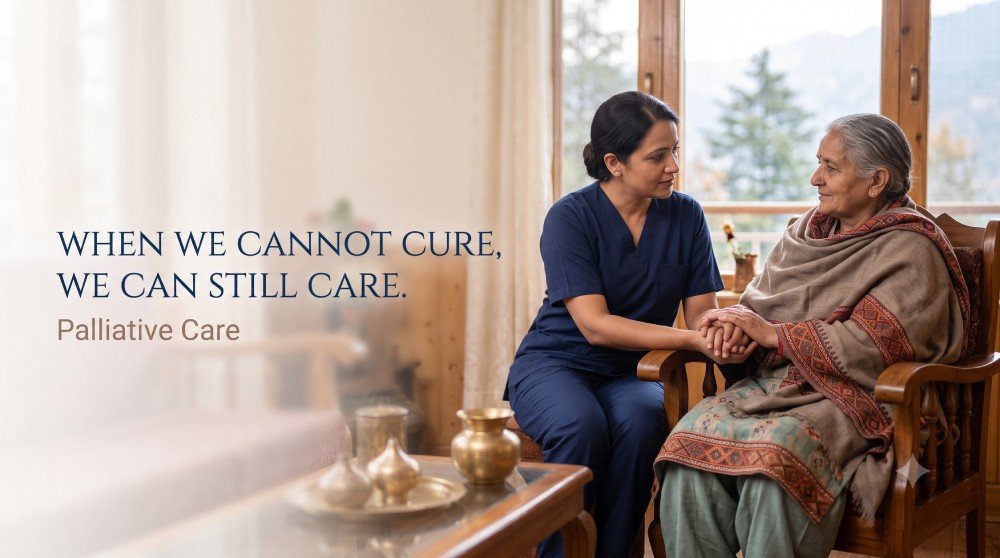
When We Cannot Cure, We Can Still Care
We are taught to think of illness in terms of battles.
There is a diagnosis, and then there is a plan. Find the right doctor. Start the treatment. Fight harder. Look for another option if the first one does not work. Hope becomes tied to outcomes, and care becomes synonymous with action.
So when someone we love has a serious or life-limiting illness, we instinctively ask, “What more can we do?”
Palliative care taught me to ask a different question. “What does this person need now?”
Sometimes the answer is another treatment. Sometimes it is better pain relief. Sometimes it is help with breathlessness, nausea, anxiety, or sleeplessness. Sometimes it is a conversation about what the person wants, what they are afraid of, or what matters most to them.
And sometimes, it is simply having someone there.
Palliative care is often misunderstood as something that begins when medicine has run out of options. As though choosing comfort means stopping care.
It is not.
Palliative care is care.
It recognises that serious illness affects far more than the body. It affects families, relationships, emotions, finances, routines, identities, and the very way a person imagines their future. It brings attention to all of these dimensions of suffering and tries to make the journey more manageable, more comfortable, and more dignified.
It also reminds us that a person should never become invisible behind a diagnosis. There is still a person who wants to be heard.
Someone who may be frightened.
Someone who may have questions they have been unable to ask.
Someone who may want to be at home rather than in a hospital.
Someone who may want their pain controlled well enough to talk to their family. Someone who may have unfinished conversations.
Someone whose family may need as much support and understanding as they do. This is where palliative care changes the meaning of what it means to “do something.”
We may not always be able to change the course of an illness. But we can treat pain. We can manage symptoms. We can address emotional and psychological distress. We can help families understand what is happening. We can support difficult conversations and help people make choices that reflect what is important to them.
We can care.
There is a particular kind of helplessness that comes with loving someone you cannot make well.
You search for answers because searching feels better than standing still. You read, research, call people, ask questions, look for one more possibility. You want to believe that if you work hard enough, you will find the thing that changes everything.
But there are illnesses that cannot be negotiated with.
And when that realisation comes, it can feel as though you have been left with nothing to offer.
Palliative care helped me see that this is not true.
When cure is not possible, care does not become meaningless.
In fact, it can become even more intentional.
The goal may shift from asking, “How do we defeat this disease?” to asking, “How do we make this person’s life better today?”
That might mean a carefully managed dose of medicine that allows someone to sleep through the night.
It might mean relieving pain enough for them to sit with their family.
It might mean helping a caregiver understand what to expect, instead of being terrified by every new symptom.
It might mean respecting a person’s wishes when they can no longer speak for themselves. It might mean sitting beside a bed without trying to fill the silence.
None of these things sound like victories in the conventional sense.
But perhaps we have defined victory too narrowly.
Because there are moments in serious illness when comfort is a victory. A pain-free afternoon can be a victory.
A peaceful night can be a victory.
A meaningful conversation can be a victory.
Being able to remain at home, surrounded by familiar things and familiar people, can be a victory.
And sometimes, being able to say goodbye without fear and without unnecessary suffering can be one too.
Palliative care does not take away the uncertainty of illness. It does something more honest.
It makes sure that people do not have to face that uncertainty without care.
It reminds us that dignity matters even when cure is not possible. That comfort matters. That the family’s suffering matters. That listening is a form of care. That honest conversations are a form of care. That presence is a form of care.
And perhaps this is what I have come to understand about love as well. Love cannot always save.
It cannot always fix.
It cannot always change the ending.
But it can pay attention to what is needed along the way. It can sit closer.
It can listen.
It can ask instead of assume.
It can hold a hand.
And with the support of good palliative care, it can help ensure that even when an illness cannot be cured, the person living with it is never reduced to the illness itself.
There may be a point when we cannot add more time.
But there is still so much we can do with the time that remains. We can relieve suffering.
We can preserve dignity.
We can support families.
We can honour choices.
We can make room for what matters. We can care.
And sometimes, that is where hope finds a different meaning.
